Monday, August 24, 2009
Ethanol and the Food Crisis
Resigned myself to the reality that I don't have time to condense this. Read it in all of its original glory . Good to write, even better to read :p


Wednesday, March 4, 2009
A Closer Look at Haiti and the US' Continued Role in the Food Crisis
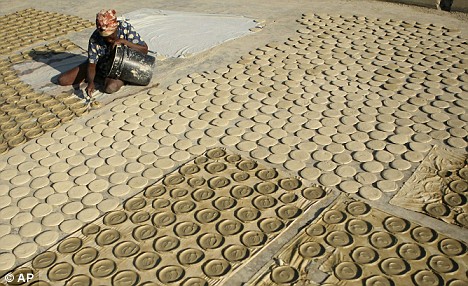
A woman prepares mud cakes to sell for food. Mud cakes, made by mixing oil, sugar, and mud, have grown in popularity as a means to take the edge off of hunger. Associated Newspapers (UK), August 2008.
Haiti by the Numbers
GDP Per Capita: $573.70 (about $1.57 per day)
On average, Haitians spend 75% of their income on food alone
In the US, if you spend over 1/3 of your income on food, you are considered impoverished.
80% of Haitians live in abject poverty(2003)
Haiti also has one of the largest wealth disparities in the world
Following the debt crisis of the 1980s, Haiti now owes $1.5 billion dollars in loans. For all of the aid money flowing from the US to Haiti, more of it is flowing back to us in the form of debt payment
66% of Haitians are farmers although it only comprises 30% of the GDP.
Literacy rate: 52.9%, the lowest in the region. Only 20% of children make it to high school
Haiti has always been unstable – most lately, the riots that broke out last April reinforced the notion that Haitians need to “get their act together.”
April 8, 2008:
"UN Peacekeepers fired rubber bullets and used tear gas to control mobs rioting over rising food prices in Haiti... for months, Haitians have compared their hunger pains to "eating Clorox" because of the burning feeling in their stomachs" - The Guardian, UK
April 18, 2008:
Marc Lacey of the New York Times publishes a compassionate article for the victims of the spike in food prices, but says "Haiti, its agriculture industry in shambles, needs to better feed itself."
Before 1986, Haiti was self-sufficient in rice production
Nineteen Eighty-Six
January - February: Dictator Baby Doc is ousted by the US government. He flees, taking with him all of the money in Haiti's treasury
April: American Rice, Inc., succeeds in lobbying Congress for subsidies on their rice. They can now sell rice that costs $400 to produce for only $250
December 30, just eight months later, the International Monetary Fund, influenced heavily by US businesses, offers a $24.6 million loan to Haiti - with the stipulation that they would cut public spending and liberalize their trade policy - that is, virtually take away their tariffs on imported goods. Haiti, about to default to bankruptcy, accepts.
1987-Present
Subsidized US rice floods the country. Haitian consumers rejoice at the low prices. Within two years, most subsistence farmers are put out of business.
The newly-subsidized American Rice, Inc., gradually secures its monopoly over the Haitian market. Haiti becomes the #3 importer of American rice in the world.
No longer producing its own food, Haiti transforms from a net exporting country to a net importer. It becomes very sensitive to changes in the global food market.
Millions of people move from rural areas to urban areas to find work. In cities, all food is purchased, not grown, leaving the urban population especially sensitive to the globalized economy.
Now, Haiti is sensitive to the global food market. When prices rise, people starve, and then riot. It is stuck in debt, imports more than it exports, and its political and economic policies are indirectly controlled by the people they owe money to - notably, the World Bank and the IMF
Why Did the IMF include stipulations to liberalize the economy?
Theory #1: The IMF believes int the "free market theory" and that capitalism is best for all. Providing cheap rice to impoverished people can't be bad, right?
Theory #2: The US wanted to flood Haiti's market with rice so that we (and American Rice, Inc., which was struggling in the international markets) could gain a major importer of our goods
Theory #3: The IMF, created after WWII to regulate the international currency to the gold standard, lost its mission in 1971 when the gold standard was suspended.
Since then, it has been looking for a reason to exist. It established itself as global economic policeman. It began with loans during the oil crisis of the 1970s, to more powerful loans during the debt crisis of the 1980s.
The IMF has emerged as one of the most powerful organizations in the world, powerfully influencing the political, social, and economic policies of virtually every developing country in the Western Hemisphere.
First-Hand Accounts of the Impact of Subsidized Rice
"American rice invaded the country. It was sold for so little that we could not compete. There was a very serious struggle. When they brought the [American] rice up from Port-au-Prince, they had to escort it in military convoys, to prevent us from seizing it. By 1987 and 1988, there was so much rice coming into the country that many of us stopped working hte land," - Charles Suffrard, rice farmer.
“Within less than two years, it became impossible for Haitian farmers to compete with what they called ‘Miami rice.’ The whole local rice market in Haiti fell apart as cheap, US-subsidized rice, some of it in the form of ‘food aid,’ flooded the market. There was violence, ‘rice wars’ and lives were lost.” – Dr. Paul Farmer
“In the 1980s, imported rice poured into Haiti, below the cost of what our farmers could produce it. Farmers lost their businesses. People from the countryside started losing their jobs and moving to the cities. After a few years of cheap imported rice, local production went way down.” – Fr. Gerard Jean-Juste
Recent History
March, 2000 - 60 rice farmers and their families pool their money and buy a rickety boat to sail 150 miles north to some British islands to escape their poverty. The boat capsized, killing everyone on board.
In Haiti, most former farmers are living in the slums of the city.
“I come here every day in the hope that one day there will be work, but there never is. When I leave the house, my children hope that I will earn enough money to come back with food. But very often, I have to walk home because I don't have enough money for a bus.” - former farmer living in the slums of Port-au-Prince
With employment down, and importation up, urban Haitians are very sensitive to changes in food prices.
From 2007 - 2008, the price of basic foodstuffs went up 40%.
Two factors contributed to the outbreak of riots around the world in April - an announcement of new subsidies for the biofuel industry, and a spike in rice prices.
The US is a central exporter of rice and corn, two basic foodstuffs. The price of both have risen drastically in the last few years.
Why?
Next - Ethanol and the Food Crisis
Tuesday, December 23, 2008
City of Williamsburg, by the numbers
http://www.city-data.com/ has more numbers than you'll ever need for any city you could ever want to know about. There's data for both the City of Williamsburg and Williamsburg the county.
Some interesting/relevant tidbits:
(Williamsburg city)
Population in July 2007: 12,434. Population change since 2000: +1.7%
Estimated median household income in 2007: $46,254 (it was $37,093 in 2000)
Estimated median house or condo value in 2007: $427,735 (it was $182,000 in 2000)
Mean prices in 2007: All housing units: $500,825
2008 cost of living index in Williamsburg: 104.6 (near average, U.S. average is 100)
According to our research there were 64 registered sex offenders living in Williamsburg, Virginia in early 2007.
The ratio of number of residents in Williamsburg to the number of sex offenders is 194 to 1.
Daytime population change due to commuting: +9,499 (+79.2%)
Workers who live and work in this city: 2,212 (52.2%)

Unemployment in September 2007:
Residents with income below the poverty level in 2007:
Residents with income below 50% of the poverty level in 2007:
There's a whole page with numbers on the poverty levels in Williamsburg:
http://www.city-data.com/poverty/poverty-Williamsburg-Virginia.html
(We will definitely talk about this on the first morning).
Next, if you type in "poverty in Williamsburg virginia" in Google, this memo will show up:
http://www.wrl.org/info/Demographic_Update.htm
One little bit from there caught my eye:
If you're very interested in the issue of affordable housing, here's a site that might be worth a look. Every year they have the "Va Governor's Housing Conference," a major gathering of everyone involved in the area. The presentation powerpoints can be found here (most are very technical):
http://www.vagovernorshousingconference.com/presentations.html
Out of all the presentations, those of you living in NoVA will find this one particularly relevant, as it details the unusually high number of foreclosures in the NoVA area:
http://www.vagovernorshousingconference.com/PDFs/Presentations/11_13/Economics%20of%20Homeownership/Economics%20of%20Homeownership%20-%20B%20Merchant.pdf
Some interesting/relevant tidbits:
(Williamsburg city)
Population in July 2007: 12,434. Population change since 2000: +1.7%
Estimated median household income in 2007: $46,254 (it was $37,093 in 2000)
| Williamsburg: |  $46,254 |
| Virginia: |  $59,562 |
Estimated median house or condo value in 2007: $427,735 (it was $182,000 in 2000)
| Williamsburg: | $427,735 |
| Virginia: | $262,100 |
Mean prices in 2007: All housing units: $500,825
2008 cost of living index in Williamsburg: 104.6 (near average, U.S. average is 100)
According to our research there were 64 registered sex offenders living in Williamsburg, Virginia in early 2007.
The ratio of number of residents in Williamsburg to the number of sex offenders is 194 to 1.
Daytime population change due to commuting: +9,499 (+79.2%)
Workers who live and work in this city: 2,212 (52.2%)
 |  |
Unemployment in September 2007:
| Here: | 4.1% |
| Virginia: | 2.8% |
Residents with income below the poverty level in 2007:
| This city: | 18.3% |
| Whole state: | 9.6% |
Residents with income below 50% of the poverty level in 2007:
| This city: | 9.3% |
| Whole state: | 4.3% |
There's a whole page with numbers on the poverty levels in Williamsburg:
http://www.city-data.com/poverty/poverty-Williamsburg-Virginia.html
(We will definitely talk about this on the first morning).
Next, if you type in "poverty in Williamsburg virginia" in Google, this memo will show up:
http://www.wrl.org/info/Demographic_Update.htm
One little bit from there caught my eye:
Income and Poverty
- The Census Bureau¹s model-based estimates for income and poverty should be used with caution. Still, they reflect the existence of a relatively intractable segment of the population in poverty in both James City County and Williamsburg.
- Poverty is more prevalent in Williamsburg than in James City County. Part, but not all, of this trend can be attributed to William and Mary students.
- Black youths are especially likely to live in poverty. This trend is most noticeable in Williamsburg where 49% of black youths were in poverty in 2000.
If you're very interested in the issue of affordable housing, here's a site that might be worth a look. Every year they have the "Va Governor's Housing Conference," a major gathering of everyone involved in the area. The presentation powerpoints can be found here (most are very technical):
http://www.vagovernorshousingconference.com/presentations.html
Out of all the presentations, those of you living in NoVA will find this one particularly relevant, as it details the unusually high number of foreclosures in the NoVA area:
http://www.vagovernorshousingconference.com/PDFs/Presentations/11_13/Economics%20of%20Homeownership/Economics%20of%20Homeownership%20-%20B%20Merchant.pdf
Food crises and US policy
This article explains how subsidized US rice, sold to Haiti, undercut the local Haitian farmers and precipitated a food crisis. Shows how good intentions can sometimes go awry.
http://opinion.inquirer.net/inquireropinion/talkofthetown/view/20080503-134390/US-IMF-role-in-Haitis-food-riots
This article, "Manufacturing a Food Crisis," details the role that the WTO, IMF, and US played in exacerbating hunger abroad, with particular emphasis on Mexico and the Philippines.
http://www.thenation.com/doc/20080602/bello
POSTnotes on Global Health
Apparently the UK Parliament keeps a gaggle of PhDs on-hand to write 4-page briefs for them about the latest trends in science and technology. There's also a fair amount relevant to both national and global health. Since there are so many, I'd suggest reading the ones on topics in which you are interested-- although since they're only four pages, they tend to go by fairly quickly.
POSTs related to national health (in the UK)
Health Behaviour
http://www.parliament.uk/documents/upload/postpn283.pdf
Ethnicity and Health
http://www.parliament.uk/documents/upload/postpn276.pdf
POSTs related to developing countries
HIV/AIDS in developing countries
http://www.parliament.uk/documents/upload/postpn210.pdf
Fighting Diseases of Developing Countries
http://www.parliament.uk/documents/upload/POSTpn241.pdf
Access to Medicines in the Developing World
http://www.parliament.uk/post/pn160.pdf
Tackling Malaria in Developing Countries
http://www.parliament.uk/documents/upload/postpn284.pdf
Food Security in Developing Countries
http://www.parliament.uk/documents/upload/postpn274.pdf
Adapting to Climate Change in Developing Countries
http://www.parliament.uk/documents/upload/postpn269.pdf
***
Full List of publications on "Science, Technology, and the Developing World"
http://www.parliament.uk/parliamentary_offices/post/postpublicationsdevelopment.cfm
Full List of publications on biological sciences and health
http://www.parliament.uk/parliamentary_offices/post/biology.cfm
Obesity and Global Health
Newsweek interviews Barry Popkin, author of "The World is Fat," who offers some suggestions on why obesity is on the rise globally. His main argument seems to be the growth of an "obesogenic environment," i.e a surplus of food plus a culture of inactivity.
http://www.newsweek.com/id/175954
Some interesting points at the end, too, on the subject of intervention:
http://www.newsweek.com/id/175954
Some interesting points at the end, too, on the subject of intervention:
Some people are going to respond to all this by saying it should be a matter of individual responsibility — that diet and weight are a matter of choice and the government shouldn't meddle.
That's OK if those people want to pay for the extra health-care costs that come with obesity. But right now this is affecting everyone in America, because we all pay those costs. It's the same issue we had with seatbelts. People who didn't use them were only hurting themselves, physically, but in the process, they were raising insurance costs for everyone. Now we are at a point where people can't even walk and they need scooters to get around, where we have to build special beds and chairs in hospitals, where we're taking toes and feet off people that have diabetes. If the government is going to pay for all of this, that affects everyone, and we need to do something about it. But America is a society that prefers to break things and then pay to fix them.
Unemployment
Brief article on the state of joblessness in America right now.
http://money.cnn.com/2008/12/18/news/economy/jobless_claims/?postversion=2008121810
Takeaway:
http://money.cnn.com/2008/12/18/news/economy/jobless_claims/?postversion=2008121810
Takeaway:
The Labor Department said that initial filings for state jobless benefits fell to 554,000 for the week ended Dec. 13. That was a decline of 21,000 from the 26-year high of a revised 575,000 claims a week earlier.
A week ago, the government reported the highest number of jobless claims since Nov. 27, 1982 when initial filings hit 612,000.
Subscribe to:
Posts (Atom)

 Posts

